The Hidden Role of Mangroves in Protecting Florida’s Gulf Coast

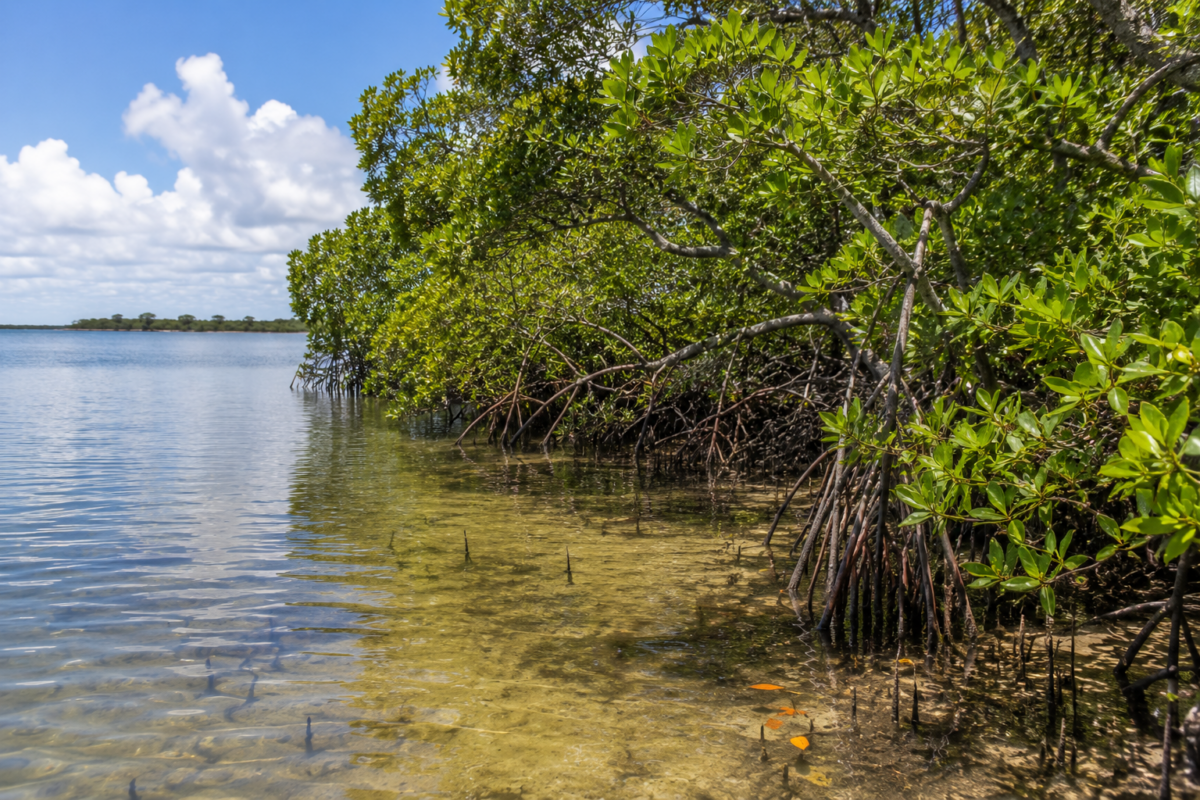
At first glance, mangroves may look like tangled coastal trees growing where land and water meet. Beneath the surface, however, an extraordinary natural system is at work.
Florida mangroves help stabilize shorelines, provide habitat for wildlife, support young fish, filter water, and reduce some of the impacts associated with waves and storm surge.
For visitors exploring Florida’s Gulf Coast, understanding these trees adds another dimension to the landscape.
What Exactly Is a Mangrove?
Mangrove doesn’t refer to a single species.
Florida has three native species: red mangrove, black mangrove, and white mangrove.
Each has its own characteristics and tends to occupy somewhat different portions of the coastal environment.
Red mangroves are perhaps the easiest for visitors to recognize because of their distinctive prop roots. Black mangroves can excrete salt through their leaves, while white mangroves generally occur farther inland within the intertidal environment.
Together, these trees form remarkably valuable coastal habitats.
Florida Mangroves Help Stabilize Shorelines
One of the most important functions of Florida mangroves happens around their roots.
Mangrove root systems slow the movement of water and help trap sediment. This can reduce erosion and stabilize shorelines.
The Florida Department of Environmental Protection explains that mangrove forests help reduce erosion caused by waves, tides, currents, and storm surge.
UF/IFAS similarly notes that the dense root systems can slow water movement during storm surge and dissipate wave energy.
In a coastal state regularly exposed to powerful storms, that natural protection matters.
They Provide Habitat for Young Fish
Look underneath the water around mangrove roots and another important function becomes clear.
The complex network creates shelter for aquatic life.
Florida DEP notes that mangroves provide nursery habitat for many fish and shellfish species. UF/IFAS also explains that mangrove roots provide shelter for many recreationally and commercially important fish species in Florida.
Young fish can use the tangled habitat for protection while they develop.
That means the trees lining a shoreline can influence ecosystems extending well beyond the visible mangrove forest.
Mangroves Support Birds and Other Wildlife
The benefits aren’t limited to animals underwater.
Mangroves provide shelter, nesting areas, and habitat for numerous wildlife species. Florida DEP identifies coastal birds including great egrets, little blue herons, and brown pelicans among species that can use mangrove environments.
For visitors interested in birdwatching or wildlife photography, mangrove areas are therefore worth observing carefully.
As always, wildlife should be viewed from an appropriate distance, particularly around nesting birds.
They Help Maintain Water Quality
Mangroves also work as natural filters.
Florida DEP explains that mangrove forests can remove nutrients and pollutants from stormwater runoff before those substances reach habitats such as seagrass beds and coral reefs.
UF/IFAS describes mangroves as important filters that help maintain water clarity for nearby marine ecosystems.
It is a good reminder that coastal ecosystems are connected. What happens along the shoreline can influence environments farther offshore.
Mangroves Can Reduce Coastal Flooding and Storm Impacts
Mangroves cannot stop hurricanes or eliminate coastal flooding, but research shows that they can help reduce some impacts.
Their roots and vegetation slow moving water, while mangrove environments can absorb and hold water.
UF/IFAS reports research estimating that mangroves prevented about $1.5 billion in storm damage during Hurricane Irma and protected more than 626,000 people across Florida.
This is one reason mangrove conservation has significance beyond wildlife protection.
Healthy coastal ecosystems can also provide practical benefits to nearby communities.
Mangroves Are Moving Farther North
Mangroves are tropical plants, which historically limited their range because they are vulnerable to freezing temperatures.
However, their distribution is changing.
UF/IFAS researchers have documented mangroves becoming more common farther north along Florida’s shorelines as temperatures warm, including portions of the Gulf Coast.
Another UF/IFAS resource notes that mangroves occur as far north as Cedar Key on Florida’s west coast.
For Nature Coast visitors, that makes mangroves an especially interesting part of Florida’s changing coastal environment.
Florida Mangroves Are Protected
Visitors and property owners should remember that Florida mangroves are protected.
Florida regulates mangrove trimming, and property owners may need to follow specific requirements depending on the work being performed. UF/IFAS recommends contacting the Florida Department of Environmental Protection for guidance before undertaking trimming or management.
For visitors, the best approach is much simpler: observe mangroves without disturbing them.
Look Beyond the Trees on Your Next Nature Coast Trip
One of the pleasures of exploring Florida’s Nature Coast is discovering how much is happening within landscapes that initially appear quiet.
Mangroves demonstrate this perfectly.
Their roots help stabilize shorelines. Their branches provide wildlife habitat. Their underwater structures shelter fish. They filter runoff and can help lessen some coastal storm impacts.
So, the next time you encounter Florida mangroves while exploring the Gulf Coast, look beyond their unusual roots and dense branches. You’re looking at an ecosystem performing several important jobs at once.
For travelers using Inglis as a base for exploring the region, Village Pines’ guide to the history of Inglis and its outdoor recreation also provides useful background on the waterways and natural environment that helped shape the area.